
CAPEX & Depreciation
Track capital spending against budget, commitments, in-service dates, depreciation and net book value.
The report as it appears in Excel
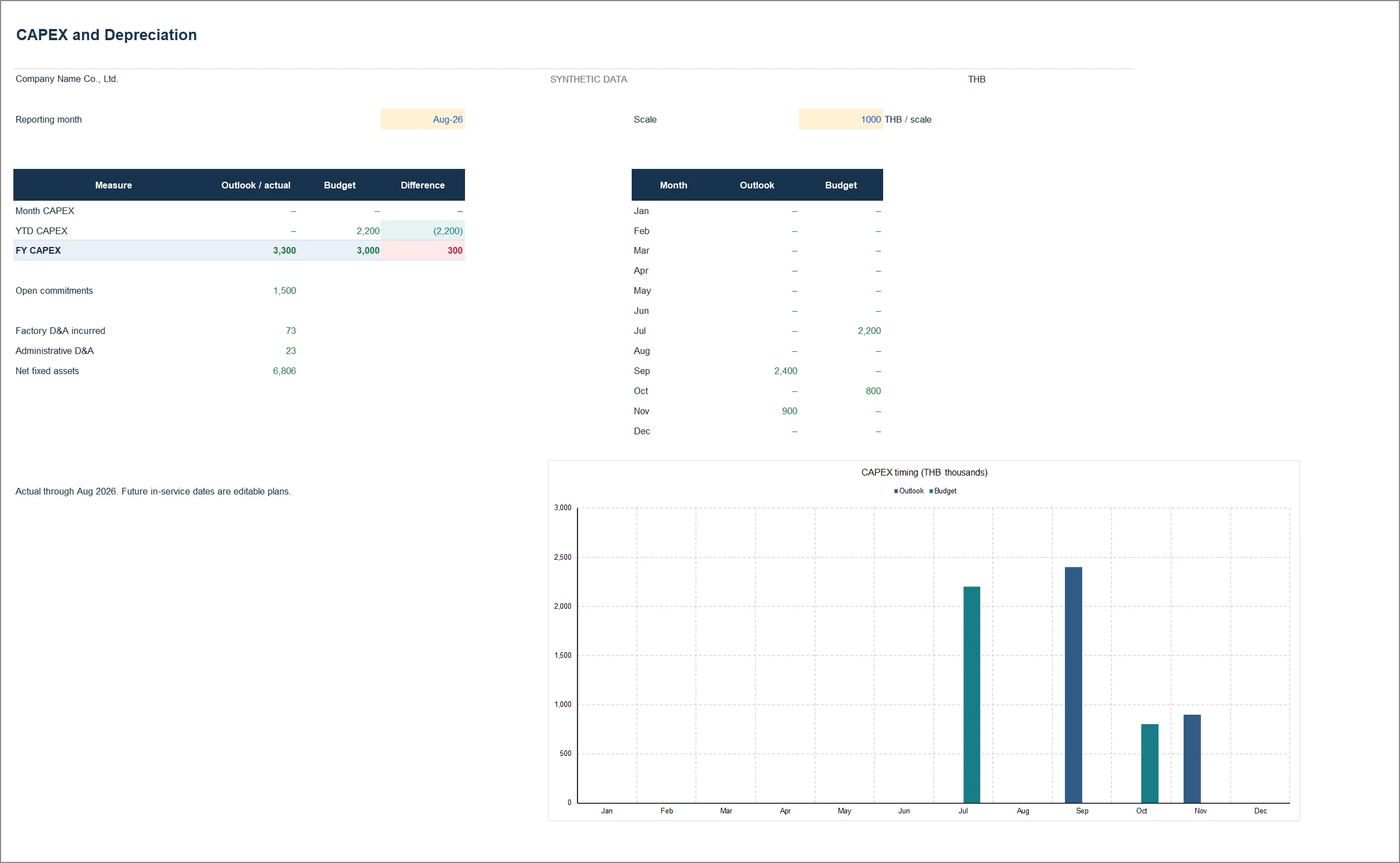
Captured from 07_CAPEX_and_Depreciation_EN.xlsx, sheet CAPEX Review, after recalculation in Microsoft Excel. Click the image to zoom. Open full-size image
Figures from the sample workbook
| Measure | Amount | Unit |
|---|---|---|
| Asset cost, Production machine B | 2,400,000 | THB |
| Residual value | 240,000 | THB |
| Useful life | 96 | Months |
| Monthly depreciation | 22,500 | THB/month |
This table uses full THB; useful life is in months
Reading order
- Check the asset register, cost, residual value, useful life and in-service month.
- Separate the cash investment from depreciation recognised over time. This example pays the full cost in the in-service month.
- Compare timing and investment amounts with budget, then review outstanding commitments and net book value.
Reading the figures in a worked case
An asset costing THB 2,400,000, with THB 240,000 residual value and a 96-month useful life, generates THB 22,500 monthly depreciation. Cash is paid upfront in this example; depreciation is recognised over its useful life.
How it is calculated, in plain language
Do not add outstanding commitments again to CAPEX already paid. The pack starts full-month depreciation in the in-service month and does not model disposals, impairments or leases.
See this number → check what → weigh which decision
Example cases from the synthetic August 2026 data. Every figure comes from the same Excel dataset; the interpretation is a starting point, not a business conclusion.
- You see
Production machine B costs THB 2,400,000 and enters service in September 2026, against a budget of THB 2,200,000 in July 2026
- Check next
It is THB 200,000 over budget and 2 months late. The delay defers THB 22,500 of monthly depreciation, so this year's profit benefits from the slip while the full cash outflow lands in September, as report 05 shows.
- Decision to weigh
Whether to accept the overrun and the later capacity, or re-scope the project, and who must approve the excess.
- You see
Open commitments of THB 1,200,000 for Production machine B and THB 300,000 for Warehouse equipment
- Check next
Commitments are a separate disclosure, not added to the THB 3.3m Sep–Dec CAPEX that already contains both assets at full cost. Check the purchase orders for when the balance falls due and reduce the commitment as it is settled.
- Decision to weigh
Whether to negotiate payment terms away from the tightest cash months, and whether the model's 'paid in full in the in-service month' assumption still describes reality or needs changing.
- You see
Total depreciation of THB 95.6k a month in Aug 2026 rises once Production machine B and Warehouse equipment enter service
- Check next
Factory-asset depreciation flows into production cost first and reaches profit when goods are sold; it is not an immediate admin expense. Read the Depreciation sheet and the Production sheet in report 06 to see how much the new charge adds to unit cost.
- Decision to weigh
Whether manufactured product prices cover the higher unit cost, and whether target margins for those products should be reset alongside the investment.
Core calculations in the workbook
| Measure | Definition |
|---|---|
| Monthly depreciation | (Cost − residual value) / useful life in months |
| Accumulated depreciation | Monthly D&A × elapsed in-service months, capped at useful life |
| Net book value | Recognized cost − accumulated depreciation |
How to use this report in the workbook
Purpose
Track investment timing against budget, remaining commitments, depreciation and net book value.
The asset register
Edit the asset register rows 9–15: department, in-service month, cost, residual value, useful life in months, budget date/cost and open commitment.
Depreciation convention
Monthly straight-line depreciation starts in full in the in-service month, stops after useful life and preserves residual value. Confirm this convention against company policy.
The depreciation schedule
Depreciation displays Jan 2026–Aug 2027 for each asset, plus gross assets, accumulated depreciation, net assets and CAPEX. Cash investment equals full cost in the in-service month.
Open commitments
Open commitments are disclosed and not added on top of cash CAPEX. Update the commitment balance as purchase orders are settled.
What is not modelled
No disposal, impairment, construction-in-progress transfer or lease model is included. Planned assets have Actual/Planned labels based on the example August cutoff.
Reading and editing essentials
- Always check the company, reporting period and currency scale. A displayed value of 1,000 in a THB-thousands table means THB 1,000,000.
- Actual means recorded results, Budget means plan, and Forecast means estimate. Do not describe a forecast as an achieved result.
- The usual arithmetic variance is Actual minus Budget. Higher revenue or profit is generally favourable; higher costs require investigation of overspending and activity levels.
- Revenue and profit are flows that can be summed across months. Cash, receivables and inventory are balances measured at a particular date.
- Calculate aggregate margin as total profit divided by total revenue. A value of n.a. means a ratio cannot be calculated under the applicable conditions; it should not be replaced with zero without justification.
- Thai and English workbooks are independent files. Editing one does not update the other. Choose a working master, retain backups and refresh related files consistently.
- Before using company data, reconcile the accounts and check dates, version names and formula ranges. Adding rows or months may require extending formulas, charts and controls.
- Read the Checks sheet, but do not treat OK as assurance over everything. Source coverage controls focus on the selected actual month; budget and forecast coverage also need review.
- All data is illustrative. Adapt costing, tax, calendar and funding policies to the business. The pack is a starting point for management reporting.
Related workbook
07_CAPEX_and_Depreciation_EN.xlsx
Main sheet CAPEX Review / รายงานเงินลงทุน · Sources Assets + PL_Data · The workbook and Markdown guide are in the Excel pack
Use your browser’s print command to save this page as a PDF.
Common questions
How is monthly straight-line depreciation calculated?
(Cost − residual value) ÷ useful life in months. Production machine B costs THB 2,400,000 with a 240,000 residual value and a 96-month life, so it depreciates THB 22,500 a month. The file charges a full month from the month the asset enters service.
Should commitments be added to CAPEX?
No. A commitment is an amount ordered or contracted but not yet paid, shown separately for cash planning; adding it to CAPEX already recorded counts the investment twice. In the example Production machine B still has THB 1,200,000 committed.
What does delaying an asset's in-service date do to profit and cash?
Depreciation starts when the asset is ready for use, so a delay lifts this year's profit for a while without reducing what has to be paid. In the example Production machine B enters service in September 2026, 2 months later than budgeted and THB 200,000 over budget.

